Be yourself; Everyone else is already taken.
— Oscar Wilde.
This is the first post on my new blog. I’m just getting this new blog going, so stay tuned for more. Subscribe below to get notified when I post new updates.
Be yourself; Everyone else is already taken.
— Oscar Wilde.
This is the first post on my new blog. I’m just getting this new blog going, so stay tuned for more. Subscribe below to get notified when I post new updates.
Media plays a significant role in this very technological time where everyone is involved in media whether by creating it, delivering it, and/or receiving it. On all cases, one should have accumulated an adequate amount of principles that guide him/her in the process of dealing with media to avoid misinformation and false input. Media literacy not only set moral principles for how to engage with media but also examines the bigger picture of the society circulating media information. It , thus, builds a critical eye to analyze and study the content of the media and the environment the information is distributed in and how would both affect each other.
The study of media literacy skills creates awareness in issues that are being disregarded generally by the populace. Therefore, after learning about these skills one would be responsible for the holding the ethics of this knowledge and attempting to deliver those skills to other individuals. The participation in media and society, hence, would require more caution, accuracy, and thoroughness.
The documentary film Killing Gaza (2018) represents concepts from which Ristovska (2016) has discussed. First, the film applied witnessing by showing clips and videos of what is happening in Palestine, innocent Palestinian children being killed, bursted houses, and Israelis dancing and singing songs about killing children of Palestine. It also aims at bearing witness to impact the audience to make a change rather than just delivering these images of oppression. It could drive the audience to apply practices that could be helpful for Palestinians.
There are examples of proactive witnessing (Ristovska, 2016) as the whole documentary (Killing Gaza, 2018) could be categorized as such since it was planned for the purpose of showing what is happening in Palestine. In addition, inside the film there were clips of accidental witnessing (Ristovska, 2016) such as the capturing of the death of Salem Shamaly.
Through the film (Killing Gaza, 2018), there were plenty of testimonials (Ristovska, 2016) of Palestinian citizens which served for moral engagement. They delivered their own experiences and which shows more credibility and authenticity about the incidents that also brings up compassion between the audience.
The documentary (Killing Gaza, 2018) plays a role on impacting the audience. Some people might not be aware of the incidents that are happening in Palestine and they do not usually think about it. However, the film showed the terrible situations Palestinians have to face everyday and how Israelis are discriminating and killing them which lead to compassion toward Palestinians and maybe, for some, changing their notion about this issue.
References
Killing Gaza (2018). Retrieved from: https://share.mayfirst.org/s/axHoszJ69yF4NC5
Ristovska, S. (2016). Strategic witnessing in an age of video activism. Media, Culture & Society, 38(7): 1034–1047. Retrieved from: https://doi.org/10.1177/0163443716635866
Sound Map:
There are tons of fake and misleading news we see everyday especially on social media. One example of these is a recent photo that was shared saying that there is a way to know if the person has the new disease COVID-19 or not. The picture states that some Japanese doctors suggested that the person needs to hold his breath for 10 seconds, if he was comfortable and did not feel the urge to cough then he does not have the virus. It also says that we need to drink water every 15 minutes because the water can transfer the virus to the stomach which will kill the coronavirus by its acidity.
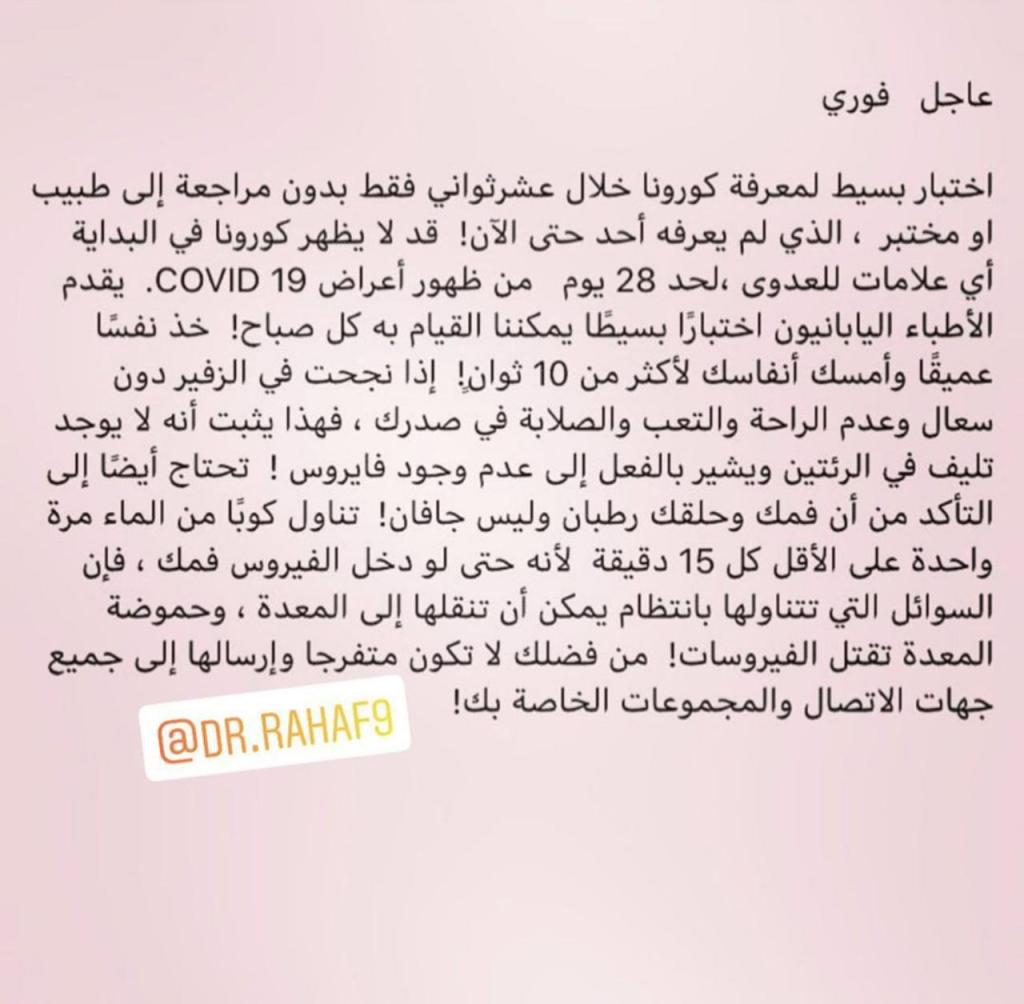
This type of information is considered bogus where the information is completely made up and false to mislead people. There is an article in BBC that refutes this information.
In order to overcome this misinformation environment in 2020, various measures should be implemented by both societies and authorities. Chenjerai Kumanyika (2018) said that we need to create a society in which it is critical in reading the media and have basic literacy skills. Misinformation and fake news spread might also penalized by authorities which could stress how important is this issue and thus prevent it.
References
European Association for Viewers Interests. (2017). Beyond fake news: Ten types of
misleading information. https://eavi.eu/beyond-fake-news-10-types-misleading-info
Kumanyika, C. (2018). Pour en finir avec les fausses nouvelles. Retrieved from:
https://www.youtube.com/watch?v=t10ErbfwG14&feature=youtu.be
Six coronavirus health myths fact-checked. (n.d.). Retrieved from https://www.google.com/amp/s/www.bbc.com/news/amp/world-51735367
Padgett (2017) mentioned how the Zapatista’s turned words into weapons and delivered their voices in 1994 in order to achieve their own autonomy and freedom where they used online and offline media strategies and tactics to overcome the oppression of the Mexican government which they did.
Furthermore, Tawil-Souri and Aouragh (2014) discussed the structural constraints that faced Palestinians in their internet activism where they discussed the term digital colonialism since the Israelis had massive control over online platforms and then controlling and restricting the content published by the Palestinian activists or citizens. They also mentioned the materiality of internet as a limitation by introducing the physical factor of internet that it is constituted of wires. The authors, in addition, highlighted the frustrations of digital activism introduced by cyber activists where they said that online activism is crucial but is never enough to defeat occupation as online work should be accompanied with practical on the ground activism to be sufficient. The huge number of accounts speaking about the same topic may also cause fragmentation and thus distracting people from the specific purpose that should be introduced.
References:
Padgett, R. (2017, February 25). Radical Legacy of the Zapatista’s Media Strategy.
Intifada! Retrieved from: http://www.svllywood.com/intifadaessays/radicalmedia
Tawil-Souri, H., and Aouragh, M. (2014). Intifada 3.0? Cyber colonialism and Palestinian
resistance. The Arab Studies Journal, 22(1): 102-133 (read excerpts pp. 102-106, 119-126
of PDF). Retrieved from:
http://www.arabstudiesjournal.org/store/p390/Intifada_3.0%3F_Cyber_Colonialism_and
_Palestinian_Resistance.html

Daraj media describes itself inits website as an independent media platform that is not influenced by political parties and is created by professional journalists. It states that it has bias toward individuals who believe in the freedom of speech and beliefs on issues related to opinions and gender which could be linked to what Forde (2011) discussed as alternative journalism where it is detached from political affiliations and is created by professional journalists. It also expresses its bias toward a certain group of people.
Furthermore, in addition to what Dunifer (2010) described as free media, Daraj media apply to this concept in the sense that it is community centered which mean that they serve individuals of the community and Daraj media focuses and issue on women, minorities, environment, and weather which is somehow unique that main stream media do not engage fully in.
However, it is limited to the concept of free media (Dunifer, 2010) since it receives its finance from organizations and foundations which could affect the voice delivered by this platform.
References:
Dunifer, S. (2010). Latitudes of Rebellion: Free Radio in an International Context [read excerpts]. In Langlois, A., Sakolsky, R., and van der Zon, M. (Eds.) Islands of Resistance: Pirate Radio in Canada. Vancouver: News Star Books. Retrieved from:http://www.newstarbooks.com/pdfs/books/9781554200504-Resistance-web.pdf
Forde, S. (2011). Chapter 1: Understanding alternative and ‘independent’ journalism [read excerpts]. In Challenging the News: The Journalism of Alternative and Community Media. New York: Palgrave Macmillan. Retrieved from: https://www.macmillanihe.com/resources/sample-chapters/9780230243569_sample.pdf
Forde (2011) presented the definition of what he called “alternative media” as media that is held by unprofessional or professional journalists which do not relate to mainstream media. The alternative media’s main target is to engage the community and the public into whether the creation of or the interaction with such media platforms where everybody could express his or her voice. Thus it is different from mainstream media in the sense that its aim is to serve the populace rather than earning profit which mainstream media focus on. In addition, it could be worked on with unprofessional media setting and journalists making it a kind of community service oriented rather than large corporates earning revenues and gaining a name.
References:
Forde, S. (2011). Chapter 1: Understanding alternative and ‘independent’ journalism [read excerpts]. In Challenging the News: The Journalism of Alternative and Community Media. New York: Palgrave Macmillan. Retrieved from: https://www.macmillanihe.com/resources/sample-chapters/9780230243569_sample.pdf
Have a WordPress.com account? Log in now.

